Your RO purifier is switched on, but the tank is not filling – or water is coming out drop by drop. Before you call a technician, go through these checks. Most of them take a few minutes, and in many cases the fix is a single inexpensive part.
Quick checklist: RO not giving water
| What you notice | Most likely cause | What to check or replace |
|---|---|---|
| No power light, no sound | Power supply or adaptor | Socket, fuse, SMPS / adaptor |
| Pump runs, but no water | Inlet closed or low supply pressure | Inlet valve, overhead tank, choked sediment filter |
| Water only drips | Choked pre-filters or membrane | Sediment filter, carbon filter, RO membrane |
| Pump does not start | Pump, adaptor or low-pressure switch | Booster pump, adaptor output |
| Water keeps going to drain, tank stays empty | Flow restrictor or float issue | Flow restrictor, float valve |
| Water flows into tank all the time and overflows | Float valve or solenoid valve stuck | Float valve, solenoid valve |
1. Check power and the adaptor (SMPS)
Make sure the socket works and the power light is on. Most domestic RO pumps run on 24V DC from an SMPS adaptor. If the light is off or flickering, or the pump is completely silent, the adaptor is a common culprit. A technician can confirm the output with a multimeter.
2. Is water reaching the purifier?
Check that the inlet ball valve is open and that the overhead tank or supply line actually has water. If the input pressure is very low, the low-pressure switch keeps the pump off to protect it – so the purifier looks “dead” even though nothing is broken.
3. Choked sediment or carbon filter
This is the single most common reason for slow or no water, especially with borewell or tanker water. If your sediment filter has turned brown or dark, replace it. The carbon filter usually needs changing along with it or soon after. See our guide on when to change RO filters.
4. Worn-out or choked RO membrane
If the pre-filters are new but water still only drips, the membrane may be scaled up. This happens faster when the input TDS is high. A membrane that is more than 1.5–3 years old, or that lets through much higher TDS than before, should be replaced. Check the right size for your purifier – most homes use a 75–80 GPD membrane.
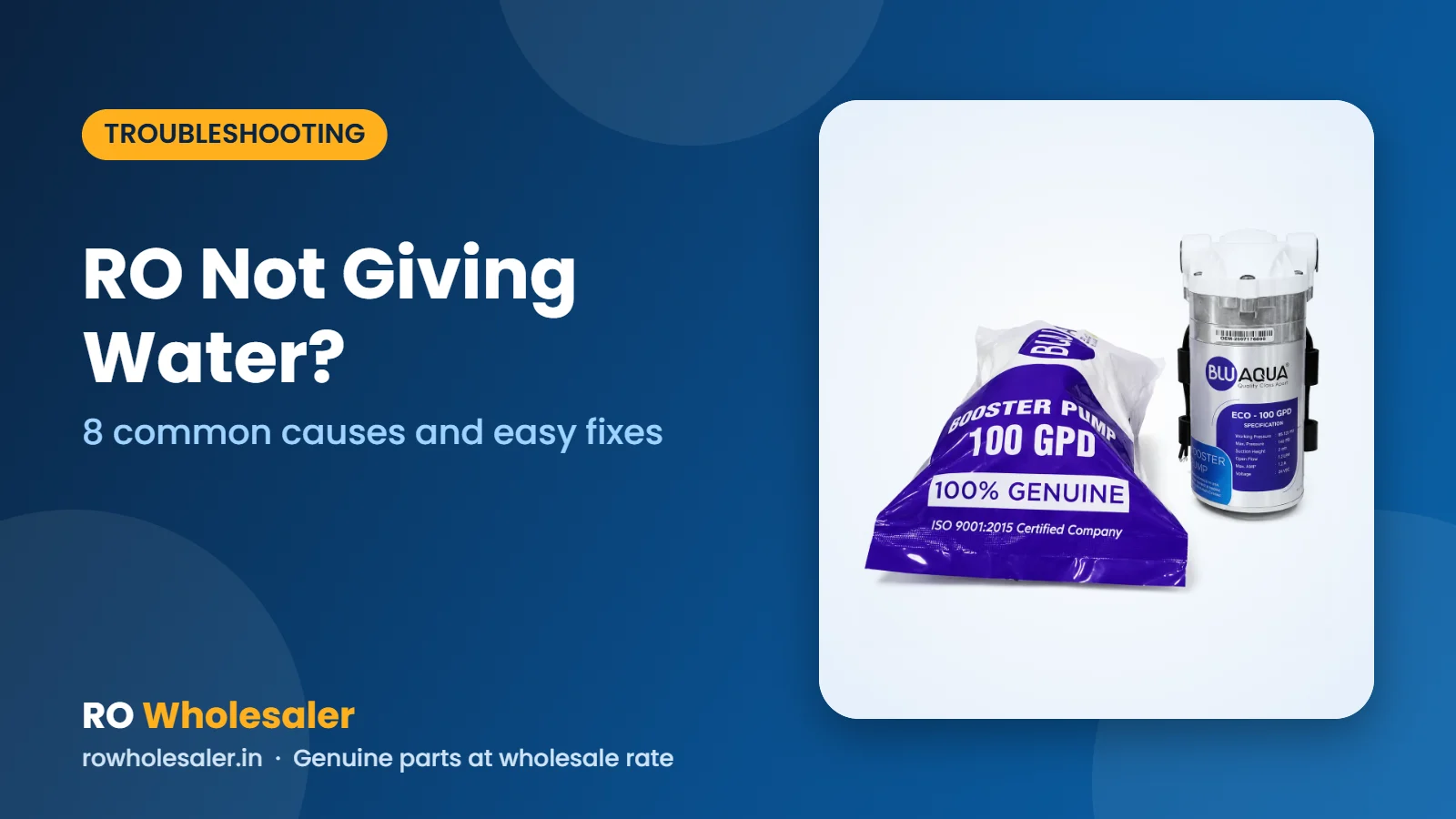
5. Booster pump not working or weak
If the pump hums but does not build pressure, or does not start at all even with a good adaptor, the pump head or motor may be failing. Unusual noise or vibration is an early warning sign.
6. Solenoid valve stuck
The inlet solenoid valve (SV) opens when the purifier is filling and closes when the tank is full. If it is stuck closed, no water enters; if it is stuck open, water keeps running to drain even when the purifier is off.
7. Float valve problem
The float valve (FLV) stops purification when the storage tank is full. If it sticks, the tank either stops filling early or overflows. It is an inexpensive part and easy to replace.
8. Flow restrictor blocked or wrong size
The flow restrictor (FR) on the drain line creates the back-pressure the membrane needs. If it is blocked, the purifier can stop working properly; if it is too large, most water goes to drain and very little comes out as purified water. The restrictor must match your membrane size.
When to call a technician
- Water is leaking from inside the cabinet
- You smell burning or see melted wires
- The pump runs non-stop even when the tank is full
- You have replaced the obvious parts and the problem continues
Not sure which part is faulty? Send a short video of your purifier on WhatsApp. Our technician will tell you what to check – free of cost – and which part fits your model.
Frequently asked questions
Why is my RO water flow so slow?
Usually a choked sediment or carbon filter, low input pressure, or an aging membrane. Start with the sediment filter – it is the cheapest fix.
Why is my RO wasting so much water?
Some reject water is normal – it carries away the removed salts. But if water runs to the drain all the time, even when the tank is full, check the solenoid valve, the float valve and the flow restrictor.
How long does an RO booster pump last?
With clean pre-filters and a stable power supply, a good pump typically lasts several years. Dry running (no input water) and voltage fluctuation shorten its life.
Need the right part for your RO?
Original filters, membranes and pumps at wholesale rates. Send us a photo of your RO – we will tell you exactly what fits.