TDS is the first number every RO technician checks – and the most common question we get on WhatsApp: “Paani ka TDS kitna hona chahiye?” Here is a clear answer, a chart you can use at home, and how to decide whether you actually need an RO purifier.
Quick answer: The best TDS for drinking water is 50–150 ppm. Up to 300 ppm is good, and 500 mg/L is the upper acceptable limit under the Indian standard BIS IS 10500:2012. Above 500 ppm, use an RO purifier. (Hindi mein: peene ke paani ka TDS 50 se 150 ke beech sabse accha hai, aur 500 se zyada ho to RO lagwana chahiye.)
What is TDS?
TDS stands for Total Dissolved Solids – the salts and minerals dissolved in water, such as calcium, magnesium, sodium, chlorides, sulphates and bicarbonates. It is measured in ppm (parts per million), which is the same as mg/L. A TDS meter reads it in a few seconds.
Safe TDS level for drinking water in India
The Indian drinking water standard, BIS IS 10500:2012, sets the acceptable limit for TDS at 500 mg/L. It allows up to 2000 mg/L only when no better water source is available. In simple words: drinking water should ideally be under 500 ppm.
TDS chart: how good is your water?
| TDS (ppm) | Water quality | What to do |
|---|---|---|
| Below 50 | Very low – almost no minerals | Fine to drink, but taste can be flat. Use a mineral/alkaline stage or set the TDS controller |
| 50 – 150 | Excellent | Ideal for drinking |
| 150 – 300 | Good | Good for drinking |
| 300 – 500 | Fair – within BIS acceptable limit | Drinkable; RO recommended if taste is salty or hard |
| 500 – 1200 | Poor – above BIS acceptable limit | Use an RO purifier |
| Above 1200 | Not acceptable for drinking | RO is needed; check the membrane and pre-filters regularly |
Is 20, 100, 300 or 500 TDS water good for health?
These are the readings people ask us about most. Use this as a quick guide for the number on your TDS meter:
| TDS reading | Is it OK to drink? | What to do |
|---|---|---|
| 20–40 ppm | Safe, but very low in minerals | Common from RO without a TDS controller. Taste can be flat – set the TDS controller or add a mineral/alkaline stage. |
| 80–150 ppm | Ideal | Nothing to do. This is the best range for daily drinking. |
| 200–300 ppm | Good | Fine to drink. Many municipal supplies are in this range. |
| 300–500 ppm | Acceptable (within BIS limit) | Drinkable. If water tastes salty or leaves white scale, an RO helps. |
| 500–1000 ppm | Above BIS acceptable limit | Use an RO purifier for drinking and cooking water. |
| Above 1000 ppm | Poor to unacceptable | RO is needed. Choose a membrane rated for high TDS and change pre-filters on time. |
BIS vs WHO: what the drinking water standards say
- BIS IS 10500:2012 (India): acceptable limit 500 mg/L; permissible up to 2000 mg/L only when no other water source is available.
- WHO: has no health-based limit for TDS. It treats TDS as a taste (palatability) issue – water under about 600 mg/L is generally considered good, and water above about 1000 mg/L becomes increasingly unpleasant to drink.
| TDS (mg/L) | WHO taste rating |
|---|---|
| Below 300 | Excellent |
| 300–600 | Good |
| 600–900 | Fair |
| 900–1200 | Poor |
| Above 1200 | Unacceptable |
Is very low TDS bad?
Water with very low TDS (below about 50 ppm) is not harmful in itself, but it tastes flat and carries very few minerals. That is why most modern RO purifiers have a TDS controller or a mineral/alkaline cartridge – to bring the output back to a comfortable 80–150 ppm range.
TDS of RO water: kitna hona chahiye?
A healthy RO membrane removes roughly 90–95% of dissolved solids. So if your tap water is 800 ppm, RO output of about 40–80 ppm is normal. Most families like the taste best at 80–150 ppm, which is why many purifiers have a TDS controller (a small valve that mixes a little filtered water back in).
- RO water below 30 ppm: safe, but adjust the TDS controller if the taste is flat.
- RO water more than 10% of input TDS: the membrane is weak or the TDS controller is open too much – see the 10% test below.
- RO water suddenly higher than usual: check the membrane, the housing O-ring and the TDS controller setting.
Typical TDS by water source
| Source | Typical TDS | Notes |
|---|---|---|
| Rain water | Very low (often under 50 ppm) | Almost no minerals. |
| Municipal / MCD tap water | Varies – often 100–400 ppm | Depends on the city and season. Test your own supply. |
| Borewell / groundwater | Often 500–2000+ ppm in many parts of north India | RO is usually needed. |
| Packaged drinking water | Check the label | Brands add minerals back, so TDS varies. |
| Sea water | About 35,000 ppm | Far too salty to drink without desalination. |
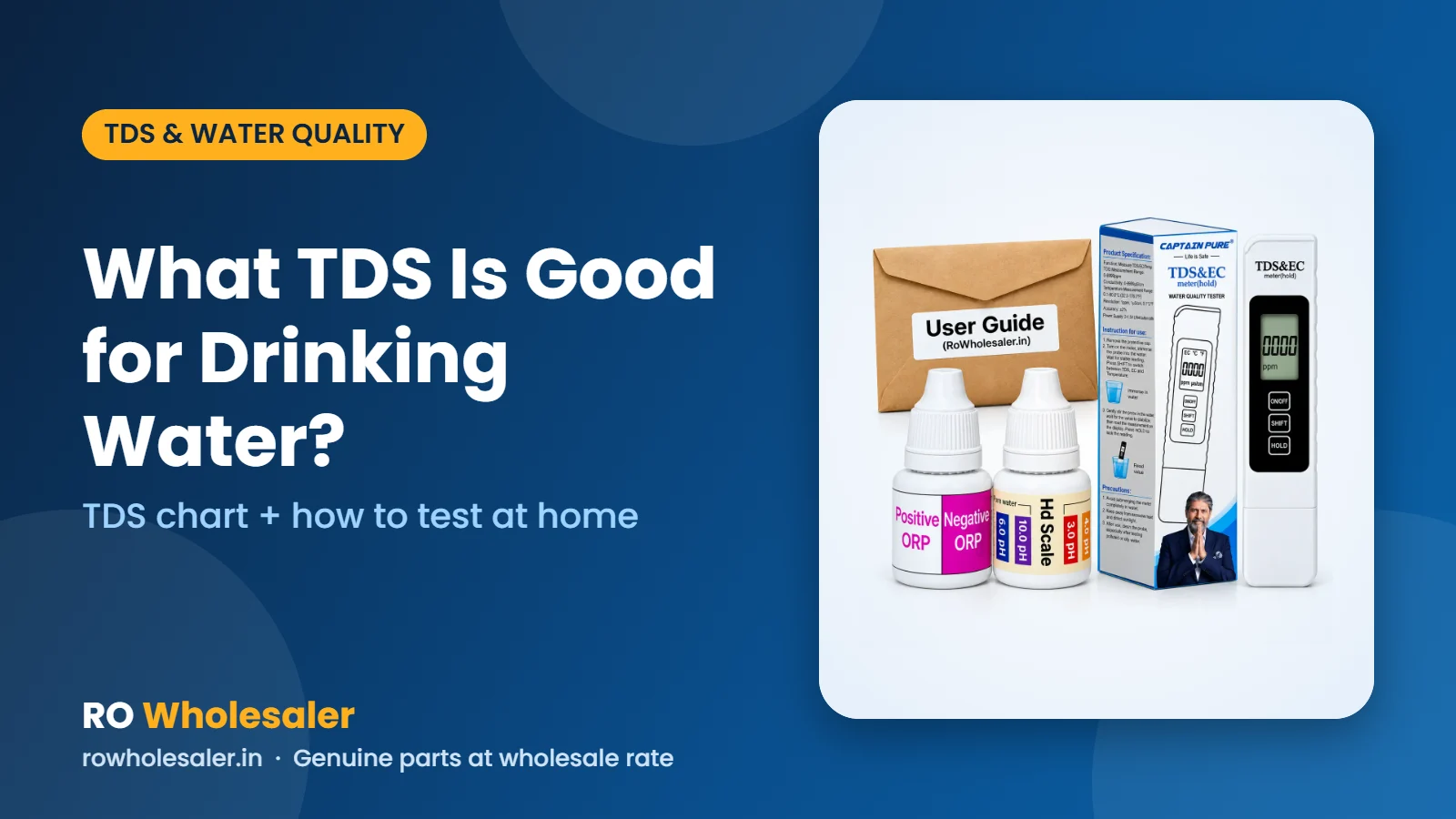
Not sure about your water? A TDS meter costs less than one technician visit. Our Water Testing Kit (TDS meter + pH drops) also checks pH. Or send us your reading on WhatsApp and we will tell you whether you need RO.
Do you need an RO purifier? Decide by your TDS
- TDS below 200 ppm (most municipal supply): you usually do not need RO. A UV + UF purifier is enough to handle germs.
- TDS 200 – 500 ppm: RO is optional. Choose RO if the water tastes salty, leaves white marks, or comes from a borewell.
- TDS above 500 ppm (borewell, tanker, many parts of Delhi NCR, Rajasthan, Haryana and Gujarat): an RO water purifier is the right choice.
How to check TDS at home
- Remove the cap of the TDS meter and switch it on.
- Dip it in a glass of water up to the marked line. Do not touch the water with your fingers.
- Stir gently and wait until the reading becomes steady.
- Test your tap water first, then the RO output, and note both readings.
- Rinse the meter with purified water and replace the cap.
Is your RO membrane still working? The 10% test
Compare the two readings. A healthy RO membrane removes around 90% or more of dissolved solids. If the output TDS is more than about 10% of the input TDS – for example, 900 ppm tap water and more than 90 ppm from the RO – the membrane may be worn out. First check whether the TDS controller has been turned up; if not, it is time for a new RO membrane.
TDS vs pH – not the same thing
TDS tells you how much is dissolved in the water. pH tells you whether the water is acidic or alkaline. BIS recommends a pH between 6.5 and 8.5 for drinking water. RO water often has a slightly lower pH, which an alkaline stage corrects.
Frequently asked questions
What is the best TDS for drinking water?
Anything between 50 and 300 ppm is good. For most families, 80–150 ppm gives the best taste.
Is 500 TDS water safe to drink?
500 ppm is the upper acceptable limit under BIS IS 10500:2012. It is not immediately harmful, but an RO purifier is recommended at this level for regular drinking.
Why did my RO water TDS suddenly go up?
The usual reasons are a worn-out membrane, a TDS controller that has been turned up, or a leak in the membrane housing O-ring. Send us both TDS readings on WhatsApp and we will help you find the cause.
Can I reduce TDS without RO?
Not in any meaningful way at home. Boiling, UV and UF do not reduce dissolved salts – only reverse osmosis does.
What is TDS in a water purifier?
It is the amount of dissolved salts and minerals left in the purified water. Many purifiers have a TDS controller to set this level, usually to 80–150 ppm for good taste.
Is 100 TDS water safe for drinking?
Yes. 100 ppm is in the ideal range of 50–150 ppm.
Is 300 TDS water good for health?
300 ppm is within the BIS acceptable limit of 500 mg/L, so it is fine to drink. If it tastes salty or hard, an RO purifier will improve it.
What is ppm in drinking water?
ppm means parts per million. For water, 1 ppm equals 1 mg/L, so a TDS meter reading of 150 ppm means 150 mg of dissolved solids in one litre.
Which RO purifier should I buy for high TDS water?
For TDS above 500 ppm, pick an RO purifier with a TDS controller and minerals stage. See our domestic RO water purifiers – all with All India delivery and Cash on Delivery.
Need the right part for your RO?
Original filters, membranes and pumps at wholesale rates. Send us a photo of your RO – we will tell you exactly what fits.