The RO membrane is the heart of your purifier – it is the stage that actually removes dissolved salts (TDS). It is also the most expensive filter, so you want to change it at the right time: not too early, and not after months of drinking poorly filtered water.
How long does an RO membrane last?
In most Indian homes a domestic membrane lasts about 1.5 to 3 years. The real life depends on three things: how hard or salty your input water is, how much water you use daily, and whether the pre-filters are changed on time.
| Input water | Typical membrane life* |
|---|---|
| Municipal / corporation water, TDS under 300 | 2–3 years |
| Mixed supply, TDS 300–800 | 1.5–2 years |
| Borewell or tanker water, TDS above 800 | 1–1.5 years |
6 signs your RO membrane needs replacement
- Output TDS keeps rising. This is the clearest sign – see the test below.
- Water tastes salty or flat even after changing the carbon filters.
- Very slow flow even though the sediment and carbon filters are new.
- Tank takes much longer to fill and the pump runs for a long time.
- White scaling or deposits in utensils and bottles from RO water.
- The membrane is over 2–3 years old and has never been replaced.
The 2-minute TDS test
Use a TDS meter. Measure your tap (input) water and then the RO output water. If the output is more than about 10% of the input – for example input 900 ppm and output above 90 ppm – the membrane is no longer rejecting salts well. If your purifier has a TDS controller (mineral valve), close it fully before testing, because it mixes some unfiltered water on purpose.
Don’t have a meter? Our Water Testing Kit includes a TDS meter and pH drops.
Is it the membrane or something else?
- Slow water but normal TDS – usually a choked sediment/carbon filter or a weak pump, not the membrane.
- No water at all – check power, inlet, solenoid valve and pump first. See RO not giving water.
- High TDS right after a service – the membrane may not be seated on its O-rings, or the TDS controller is open.
Choosing the replacement
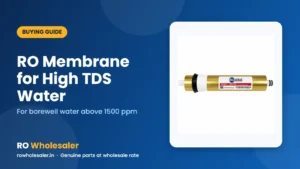
Match the size and capacity of your old membrane. Most domestic purifiers use a 1812 size membrane of 75, 80 or 100 GPD. For borewell water with high TDS, choose a membrane rated for high TDS. If the purifier has a flow restrictor, it should match the membrane capacity.
How to make your membrane last longer
- Change the sediment filter every 3–6 months and the carbon filter every 6–12 months.
- Don’t leave the purifier unused and dry for weeks – run it regularly.
- Use the correct flow restrictor so the membrane gets flushed properly.
- If your input TDS is very high, consider a pre-filter or softener on the inlet.
Frequently asked questions
What is the price of an RO membrane?
Domestic 75–100 GPD membranes on our store currently start at around ₹320; branded and high-TDS membranes cost more. Prices are listed on each product page.
Can I clean an RO membrane instead of replacing it?
Domestic membranes are not designed for home cleaning. Once the salt rejection drops, replacement is the practical fix.
Should I change pre-filters along with the membrane?
Yes. A new membrane behind old, choked pre-filters wears out fast.
Need help choosing the right part? Send a photo of your RO or its model name on WhatsApp (96252 23245) and we will tell you exactly what fits. Browse all RO membranes.
Need the right part for your RO?
Original filters, membranes and pumps at wholesale rates. Send us a photo of your RO – we will tell you exactly what fits.