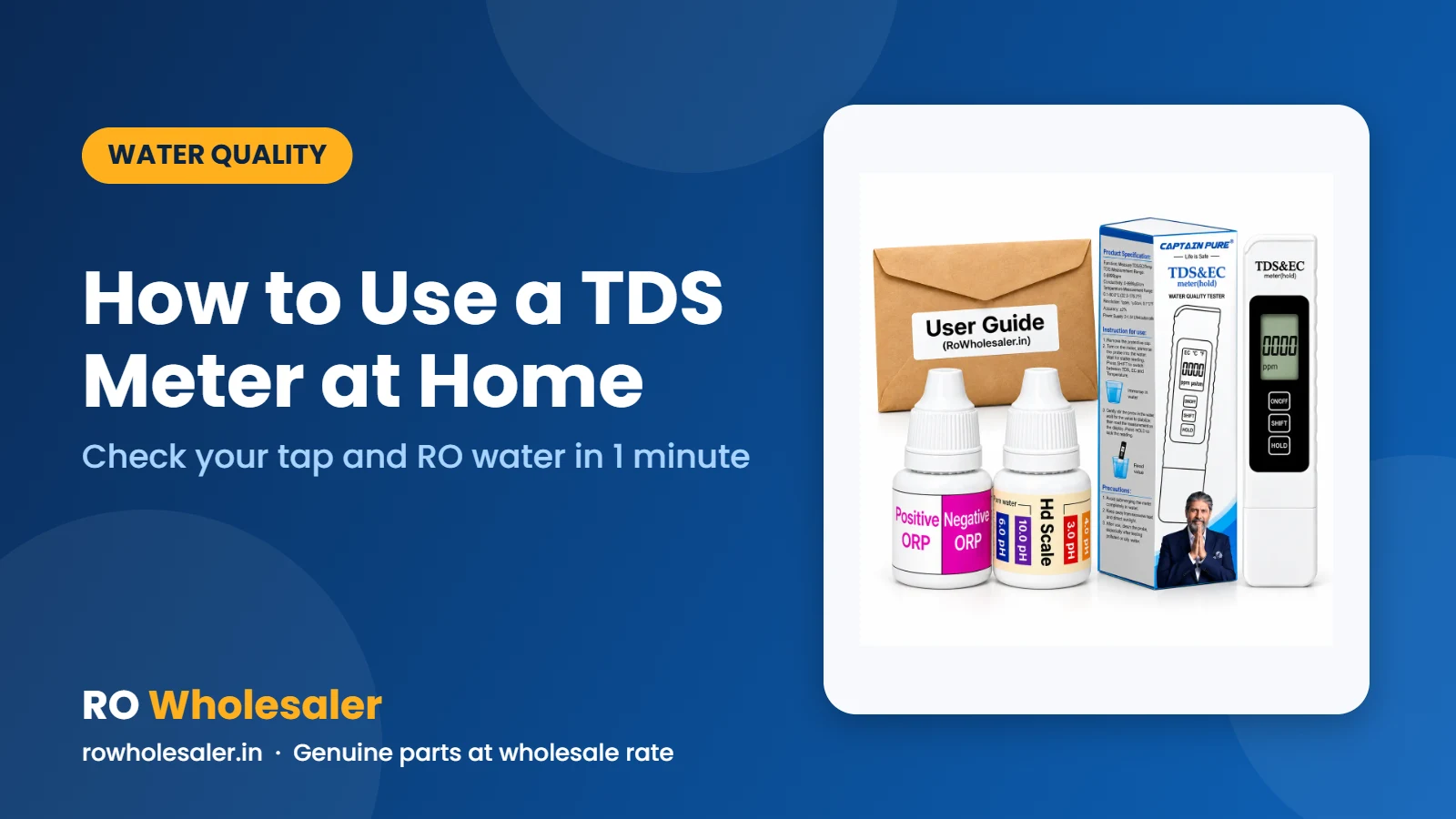
A TDS meter is the cheapest way to know whether your water needs an RO and whether your RO membrane is still working. It costs less than one technician visit and takes about a minute to use. Here is exactly how to use it – and how to read the number it shows.
What a TDS meter measures
A TDS meter measures the electrical conductivity of water and converts it into TDS in ppm (parts per million, same as mg/L). More dissolved salts mean higher conductivity and a higher reading. It does not detect bacteria, viruses, chlorine or pesticides – so low TDS does not automatically mean safe water.
How to use a TDS meter: step by step
- Remove the cap and press the ON button. Most pen-type meters show 000.
- Take water in a clean glass – not directly under a running tap, because bubbles change the reading.
- Dip the meter up to the marked line (usually 2–3 cm). Do not let your fingers touch the water.
- Stir gently to remove air bubbles and wait 5–10 seconds until the number stops changing.
- Press HOLD (if your meter has it) and take it out to read. If the screen shows x10, multiply the reading by 10.
- Rinse the tip with clean water, shake it dry and put the cap back.
Test both tap water and RO water
Always take two readings: your input water (tap, borewell or tanker) and your RO output. The first tells you whether you need RO at all; the second tells you whether your purifier is working.
| Reading | What it means |
|---|---|
| Tap water below 200 ppm | RO may not be needed – UV/UF can be enough for germs |
| Tap water above 500 ppm | RO purifier is recommended |
| RO water 50–150 ppm | Ideal for drinking |
| RO water more than 10% of tap water TDS | Membrane may be weak or TDS controller is open – check |
| RO water suddenly much higher than before | Membrane, O-ring or TDS controller problem |
Not sure what your number means? See our full TDS chart for drinking water.
The 10% test for your RO membrane
Divide RO water TDS by tap water TDS. Example: tap 800 ppm, RO 60 ppm → 7.5%, so the membrane is fine. If the result is above about 10% and the TDS controller is not turned up, it is usually time for a new RO membrane. Read when to replace an RO membrane for more signs.
Common mistakes that give wrong readings
- Testing hot or very cold water – most meters have temperature compensation (ATC) but extreme temperatures still affect readings. Test at room temperature.
- Testing straight from a running tap with air bubbles.
- Dirty or wet electrodes from the last test.
- Weak battery – readings jump around or the screen is faint.
- Comparing different meters – two cheap meters can differ by 5–10%. Use the same meter for before/after comparisons.
Do you need to calibrate a TDS meter?
Most home TDS meters come factory calibrated and work well for comparing tap and RO water. If your meter has a CAL button and you have a standard calibration solution, follow the manual. For home use, consistency matters more than absolute accuracy.
Which TDS meter should you buy?
A simple pen-type digital meter with HOLD and temperature display is enough for homes. Our Water Testing Kit (₹399) includes a TDS meter plus pH and ORP test drops, so you can check both TDS and pH of your water.
Frequently asked questions
Is a TDS meter accurate?
For home use, yes – a good digital meter is accurate enough to compare tap water and RO water and to check your membrane. Lab tests are needed only for detailed water analysis.
Can a TDS meter detect bacteria?
No. It only measures dissolved salts. Bacteria and viruses are handled by UV or UF stages in your purifier.
How often should I check TDS?
Once a month is enough. Check immediately if the taste of your RO water changes.
Why does my TDS meter show 000?
The water may be extremely low in dissolved solids (like distilled water), or the electrodes are not fully dipped. Dip deeper and stir.
Need help choosing the right part? Send a photo of your RO or its model name on WhatsApp (96252 23245) and we will tell you exactly what fits. Original parts at wholesale rates, Cash on Delivery and All India delivery.
Need the right part for your RO?
Original filters, membranes and pumps at wholesale rates. Send us a photo of your RO – we will tell you exactly what fits.